
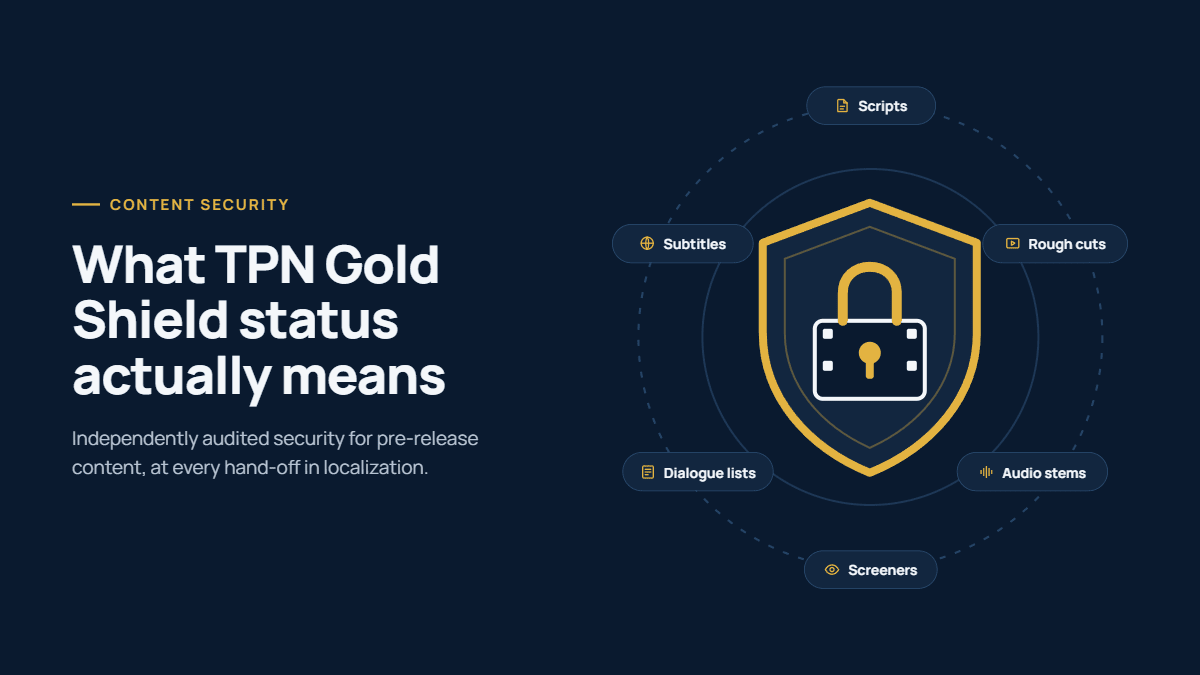
“TPN certified” shows up in a lot of vendor pitches. It means something specific, and most of what it actually covers never makes it into the marketing copy.
For studios, broadcasters, and streaming platforms handling pre-release and unreleased content, that gap matters. A certification badge is only useful if the buyer understands what it actually verifies, and asks the right follow-up questions when it doesn’t cover something they need.
What TPN Actually Is
The Trusted Partner Network is a joint initiative of the Motion Picture Association and the Content Delivery & Security Association, created to raise security standards across the entertainment industry’s vendor supply chain. It isn’t a single studio’s internal checklist: it’s an industry-wide framework, independently audited, used by vendors across production, post-production, and localization.
Gold Shield status is awarded after a TPN-accredited auditor conducts a thorough review of a vendor’s infrastructure, workflows, and access controls, verifying compliance with the industry’s best practices for securing sensitive media assets.
What the Status Actually Evaluates
A Gold Shield audit isn’t a conversation about intentions. It examines specific, verifiable practices: who can access content and under what conditions, how working copies are tracked and controlled, how obsolete versions are retired, and how the organization responds to and documents a potential breach.
A TPN assessment is a different bar from “we use secure file transfer” or “we take security seriously.” Those phrases appear constantly in vendor marketing, yet they verify nothing. Encryption in transit also isn’t enough on its own: a file can be fully protected on the way and still be mishandled once it lands.
Why This Matters More for Localization Specifically
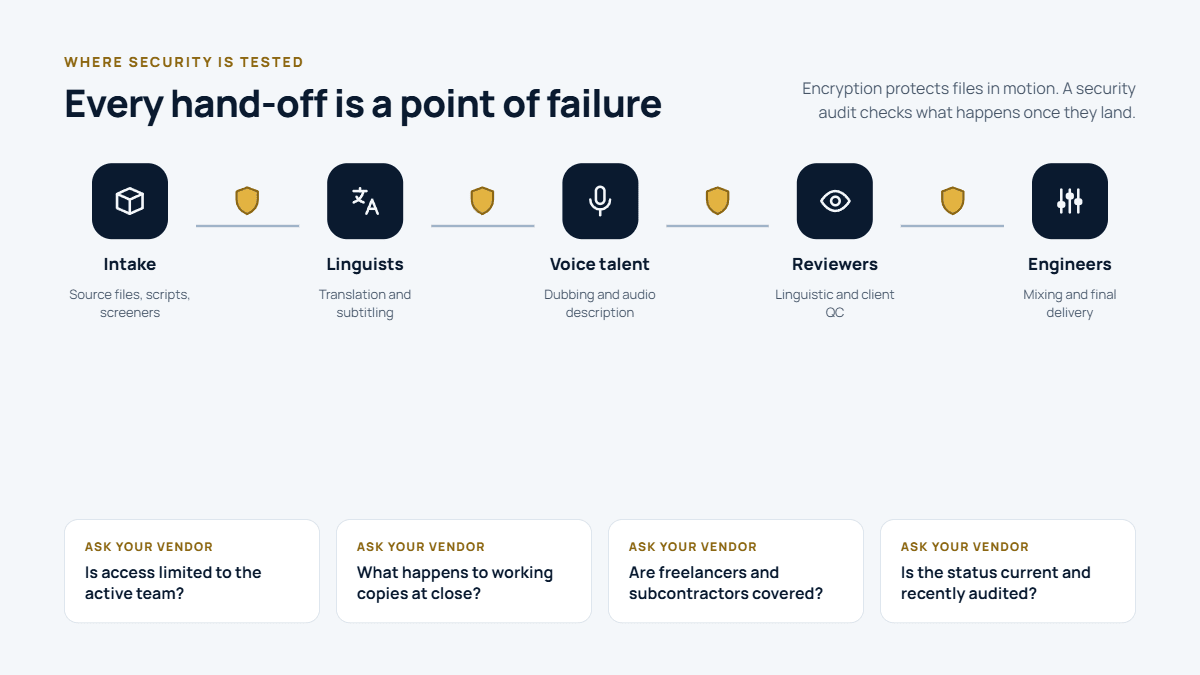
Pre-release content passes through more hands during localization than during almost any other stage of production. Scripts, rough cuts, dialogue lists, audio stems, and screeners move between linguists, voice performers, reviewers, engineers, and project managers. Often across multiple countries and time zones.
Every one of those hand-offs is a potential point of failure. A secure transfer protocol protects content in motion. It says nothing about who had local access to a working copy, whether that copy was deleted when the project closed, or whether a freelancer’s personal device was part of the chain. TPN Gold Shield status is built around exactly these questions: the parts of the security picture that don’t show up in a simple “was it encrypted” conversation.
What to Actually Ask a Vendor
Beyond confirming a vendor holds TPN status, a few follow-up questions reveal more than the certification itself:
- How is access to a project limited to only the people actively working on it?
- What happens to working copies and screeners once a project closes?
- Does the certification cover freelancers and subcontractors, or only internal staff?
- How often is the certification re-audited, and is it still current?
That last question matters more than it might seem. Security frameworks evolve: TPN’s own assessment structure has changed over time, and a status achieved several years ago under an older framework isn’t the same claim as a current one. Buyers should always confirm a vendor’s current, active status level directly rather than relying on older marketing materials.
The eSteno Standard: Security Built Into How Content Moves, Not Added On
eSteno Media Services holds TPN Gold Shield status, reflecting our approach to how pre-release and sensitive content is handled across every stage of localization:
- Access controls limiting project visibility to the team actively working on it.
- Controlled handling of working copies, screeners, and source material from intake through final delivery.
- Documented processes covering linguists, performers, reviewers, and engineers at every hand-off.
- A security posture built around independent, industry-standard audit; not internal self-assessment.
Content security in localization isn’t a single safeguard. It’s whether access stays appropriate at every point a file changes hands.
Connect with eSteno Media Services to discuss how we handle security for your next pre-release or sensitive content project.
Frequently Asked Questions
1. What is TPN Gold Shield status?
TPN Gold Shield is a content security status issued by the Trusted Partner Network, a joint initiative of the Motion Picture Association and the Content Delivery & Security Association, awarded after an independent audit verifies a vendor’s security practices meet the industry’s standards for protecting sensitive media assets.
2. Who issues TPN status and why does it exist?
TPN is jointly operated by the Motion Picture Association and the Content Delivery & Security Association. It exists to raise and standardize security practices across the entertainment industry’s vendor supply chain, since individual studios can’t practically audit every vendor that they work with on their own.
3. What questions should a studio ask a localization vendor about content security?
Beyond whether a vendor holds a TPN status or not, useful questions include: how project access is limited to active team members, what happens to working copies after a project closes, whether the certification covers freelancers and subcontractors, and how recently the company was audited.
4. Does TPN status cover freelancers and subcontractors a vendor uses?
This varies by vendor and should be confirmed directly. A status covering a vendor’s internal infrastructure doesn’t automatically guarantee the same standard applies to every freelancer or subcontractor involved in a project.
5. How often is TPN status re-audited?
TPN Gold Shield status is valid for 2 years from the publication of the assessment report, according to TPN’s own FAQ.
6. What’s the difference between TPN status and a vendor simply using secure file transfer?
Secure file transfer protects content in motion between two points. TPN status evaluates the full picture: access controls, working-copy handling, breach response, and practices across the entire project lifecycle.
7. Why does pre-release content need more security than released content?
Pre-release and unreleased material carries commercial and contractual sensitivity that disappears once content is public. A leak before release can affect marketing, distribution agreements, and revenue in ways that aren’t possible once the content has already launched.
8. Does a vendor holding a TPN Gold Shield Status guarantee zero risk of a content leak?
No status eliminates risk entirely. It verifies that a vendor’s practices meet an independently audited standard, which meaningfully reduces risk compared to vendors without equivalent verification, but it isn’t an absolute guarantee.
9. How many hand-offs does content typically go through during localization?
It varies by project, but localization often involves more parties than other production stages: linguists, voice performers, reviewers, engineers, and project managers; each representing a separate point where access and handling practices matter.
10. Should a vendor’s TPN status be reconfirmed before every project?
It’s reasonable practice, particularly for high-sensitivity pre-release content, since assessments tiers and audit cycles change over time and a vendor’s marketing materials may not always reflect their current status.