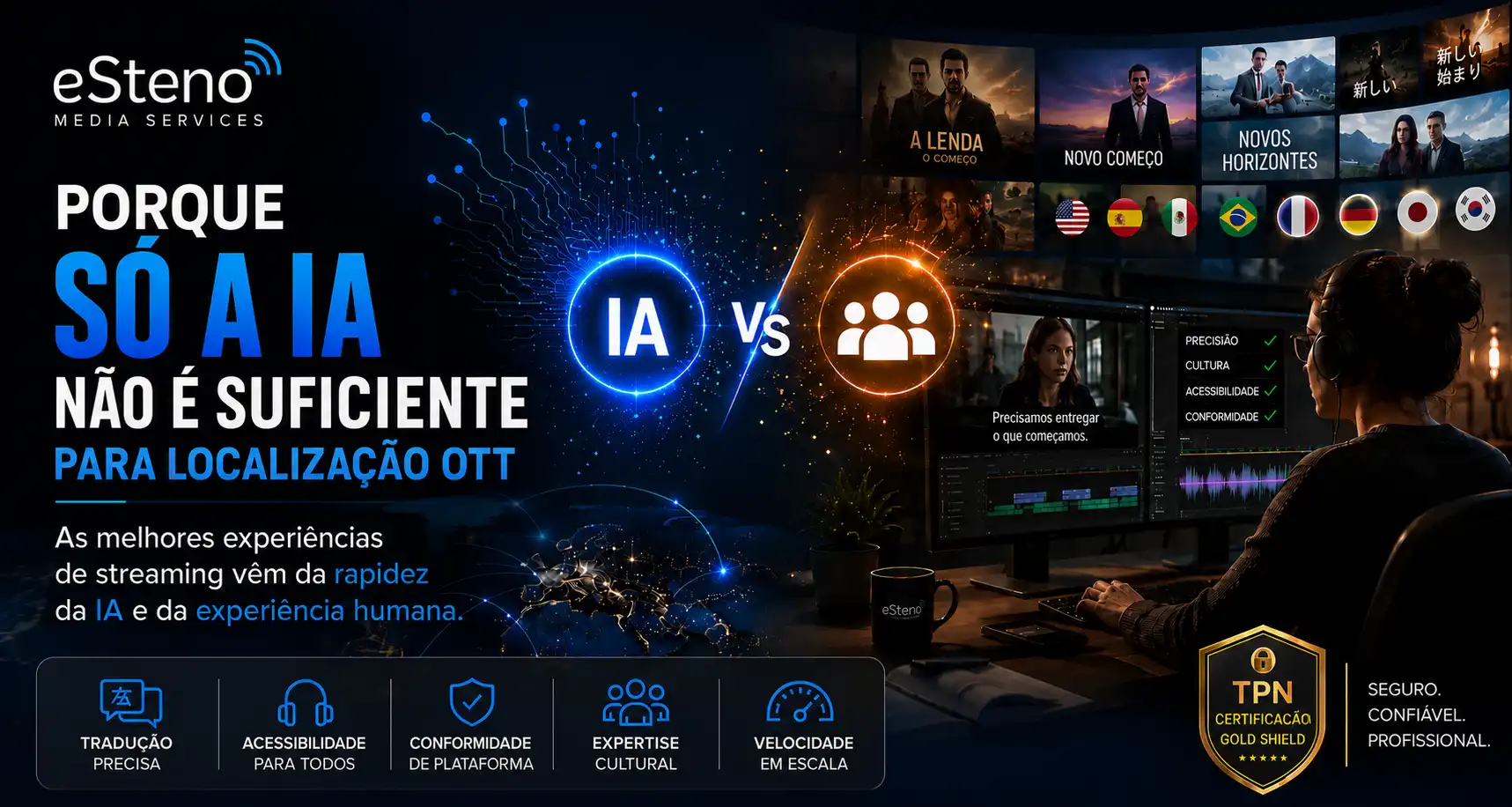
Não, a IA não consegue lidar sozinha com os serviços de localização para OTT. A IA acelera a transcrição e a tradução, mas falha com gírias, áudio ao vivo sobreposto, acessibilidade e conformidade com as plataformas. Como resultado, os melhores provedores de streaming combinam IA com revisão humana. Eles usam a velocidade da máquina para os primeiros rascunhos e linguistas especializados para a qualidade final.
Você pode passar um roteiro por uma tradução automática em segundos. No entanto, as plataformas de streaming ainda rejeitam arquivos, e os programas ainda perdem espectadores em novos mercados. Por quê? Porque a localização para OTT não é apenas um problema de tradução. Também é um problema de significado, um problema de acessibilidade, um problema de conformidade e, cada vez mais, um problema ao vivo.
A IA mudou a forma como esse trabalho é feito, e qualquer parceiro que finja o contrário já está ficando para trás. Mas a IA sozinha falha nos momentos que mais importam: a piada que não funciona, os falantes sobrepostos em um evento ao vivo, o arquivo de acessibilidade que um órgão regulador vai verificar. Fundamentalmente, a IA não consegue saber quando está errada, então seus erros podem parecer corretos. Este guia explica onde a IA falha e como é um fluxo de trabalho híbrido e moderno em vez disso.
O Que os Serviços de Localização para OTT Cobrem?
Os serviços de localização OTT cobrem tudo o que faz o conteúdo de streaming parecer nativo para um novo público. Isso inclui tradução de legendas, SDH (legendas para surdos e pessoas com deficiência auditiva), dublagem, locução, audiodescrição, closed caption, localização de metadados e adaptação cultural.
OTT significa Over-The-Top: vídeo entregue diretamente aos espectadores pela internet, como Netflix, Amazon Prime Video, Disney+ e Apple TV+. Projeta-se que o mercado de streaming cresça para centenas de bilhões de dólares nos próximos anos. Além disso, quase todo esse crescimento depende de alcançar públicos que não falam inglês como primeira língua. Como resultado, os serviços de localização de conteúdo deixaram de ser uma reflexão tardia e passaram a ser uma decisão estratégica, e um resultado automatizado "suficientemente bom" agora é um risco real.
Onde a IA Sozinha Falha na Localização para OTT?
A IA sozinha falha onde é necessário julgamento, cultura ou responsabilização. Ela é rápida e fluente, mas não sabe quando está errada. Aqui está o resultado apenas com IA versus um fluxo de trabalho híbrido:
| Tarefa | Apenas IA | IA + Revisão Humana |
| Velocidade do Primeiro Rascunho | Excelente | Excelente |
| Gírias e Expressões Idiomáticas | Requer revisão de contexto | Adaptado para o público local |
| Áudio ao Vivo Sobreposto | Requer verificação adicional | Revisado e corrigido |
| Conformidade de Acessibilidade | Requer validação humana | Revisado por especialista |
| Conformidade da Plataforma | Pode ignorar casos extremos | Conformidade verificada |
| Prestação de Contas Final | Responsabilidade limitada | Especialista humano responsável |
1. Gírias, Expressões Idiomáticas e Referências Culturais
O problema: A tradução automática é fluente, mas nem sempre correta. Uma frase como "he threw me under the bus" pode ser traduzida literalmente em uma imagem confusa de um ônibus real. O modelo pode nem a reconhecer como uma expressão idiomática.
A solução: Usar transcriação, não tradução literal. A IA cuida da primeira passagem pela velocidade. Depois, um linguista nativo adapta o significado, o tom e a intenção para a cultura de destino.
2. Falantes Sobrepostos e Áudio Confuso
O problema: O reconhecimento automático de fala (ASR) funciona bem com uma voz clara. No entanto, o conteúdo real tem conversas cruzadas, sotaques e ruído de multidão. O ASR vai mesclar com confiança dois falantes em uma linha confusa, e não vai sinalizar o erro.
A solução: Sobrepor revisão humana às ferramentas de identificação de falantes. A IA identifica os falantes e faz o rascunho do arquivo. Depois, um editor detecta a sobreposição e corrige nomes ou termos mal compreendidos. Esta é a prova mais clara de por que a revisão humana importa: os espectadores notam instantaneamente quando as palavras erradas saem da boca errada.
Por Que a Localização Somente com IA É um Risco de Responsabilização?
A localização somente com IA é um risco de responsabilização porque seus erros são invisíveis até que já tenham chegado aos espectadores. O maior risco não é que a IA produza um resultado ruim. O maior risco é que ela produza um resultado incorreto que parece correto.
Uma legenda confusa é óbvia, e alguém a detecta antes do lançamento. No entanto, uma linha fluente que traduz erroneamente e silenciosamente um nome, uma divulgação legal ou uma referência cultural pode passar por uma verificação automatizada e chegar a um público global sem ser percebida. Para conteúdo premium que carrega uma marca, esse erro silencioso é a verdadeira exposição. É gestão de risco, e é por isso que a revisão humana permanece no fluxo de trabalho mesmo com a IA ficando mais rápida.
3. Terminologia Inconsistente Entre Episódios
O problema: Se o nome de um personagem ou uma frase de efeito é traduzido de três maneiras diferentes ao longo de uma temporada, os espectadores perdem a confiança. As ferramentas de IA não mantêm consistência entre arquivos separados por conta própria.
A solução: Incorporar a gestão de terminologia ao fluxo de trabalho. Um glossário define nomes, termos e tom aprovados, e é aplicado em cada episódio. A Netflix formaliza isso por meio de tabelas de Nomes e Frases-Chave (KNP), e qualquer provedor sério deveria fazer o mesmo.
4. Legendas que Não Atendem aos Padrões da Plataforma
O problema: As plataformas são rigorosas quanto à formatação, e arquivos que falham nas verificações técnicas são rejeitados antes mesmo de um humano vê-los. A Netflix tem os padrões mais detalhados do setor, publicados em seu Guia de Estilo para Legendas.
A solução: Construir de acordo com a especificação e depois verificar com um humano. De acordo com os requisitos geraisda Netflix, as legendas compatíveis com a Netflix devem seguir limites rígidos, incluindo:
- Máximo de 42 caracteres por linha
- No máximo duas linhas na tela ao mesmo tempo
- Velocidade de leitura de aproximadamente 20 caracteres por segundo para conteúdo adulto
- Duração mínima de cinco sextos de segundo e máxima de sete segundos
- Entrega em formatos de arquivo TTML aprovados
A IA pode formatar de acordo com um modelo. No entanto, ela não consegue julgar a quebra de linha limítrofe ou a edição de velocidade de leitura que preserva o significado.
5. Acessibilidade Tratada como Ideia de Última Hora
O problema: Muitos produtores confundem legendas com closed captions e acabam ignorando a acessibilidade por completo. As legendas mostram o diálogo. Já os closed captions e o SDH acrescentam identificação de falantes, efeitos sonoros e indicações musicais. Nos Estados Unidos, a acessibilidade também é uma exigência legal sob as regras da FCC.
A solução: Tratar a acessibilidade como uma entrega essencial, não uma correria de última semana. Produzir arquivos de SDH e legendas padrão juntos como parte de cada projeto.
6. Metadados Deixados em Inglês
O problema: A capacidade de descoberta depende dos metadados: títulos, descrições, etiquetas de gênero e palavras-chave. Se você localiza o vídeo, mas deixa os metadados em inglês, os públicos locais não conseguem encontrar o conteúdo por meio de busca ou recomendações.
A solução: Localizar os metadados junto com o próprio conteúdo, incluindo descrições e palavras-chave, para que o trabalho pago para localizar seja realmente localizável.
7. Cronogramas Às Pressas que Sacrificam a Qualidade
O problema: As plataformas operam com prazos apertados. Como resultado, as equipes confiam demais na IA sob pressão de prazo final e entregam erros a milhões de espectadores.
A solução: Incorporar a localização ao cronograma de produção desde o primeiro dia. Usar a IA para comprimir o prazo, mas manter os pontos de verificação humanos em vigor.
Como É um Fluxo de Trabalho Moderno de Localização com IA?
Um fluxo de trabalho moderno combina a velocidade da IA com o julgamento humano em um processo integrado único. Cada parte faz o que faz de melhor:
- Reconhecimento automático de fala (ASR): produz uma primeira transcrição rápida.
- Tradução automática (MT): gera uma tradução de primeira passagem em escala.
- Identificação de falantes: identifica quem está falando, inclusive em conteúdo ao vivo.
- Gestão de terminologia: aplica nomes, termos e tom aprovados.
- Linguistas e editores humanos: cuidam da adaptação cultural, acessibilidade e controle de qualidade final, e são responsáveis pelo resultado.
Esse modelo, tradução automática com pós-edição humana profissional, oferece a melhor combinação de velocidade e qualidade: mais rápido que um processo totalmente manual e mais confiável que um totalmente automatizado. Na eSteno, é assim que o trabalho é construído hoje, apoiado pela certificação TPN Gold Shield, que mantém o conteúdo pré-lançamento seguro.
O Que É Audiodescrição, e É Ela Necessária?
A audiodescrição (AD) é uma faixa narrada que descreve informações visuais importantes para espectadores cegos e com baixa visão. Ela cobre ações, cenários e textos na tela, sincronizados nas pausas naturais do diálogo.
Cada vez mais, é uma questão de conformidade, não apenas uma cortesia. À medida que os padrões de acessibilidade se tornam mais rígidos nos principais mercados, a AD está deixando de ser opcional para se tornar esperada em conteúdo premium. Ela exige uma redação precisa e neutra e uma mixagem limpa sob o áudio do programa — trabalho humano apoiado por tecnologia, que a eSteno oferece dentro de seus serviços de dublagem, voice-over e audiodescrição ofertas.
Em Que a Localização ao Vivo Difere da Pré-gravada?
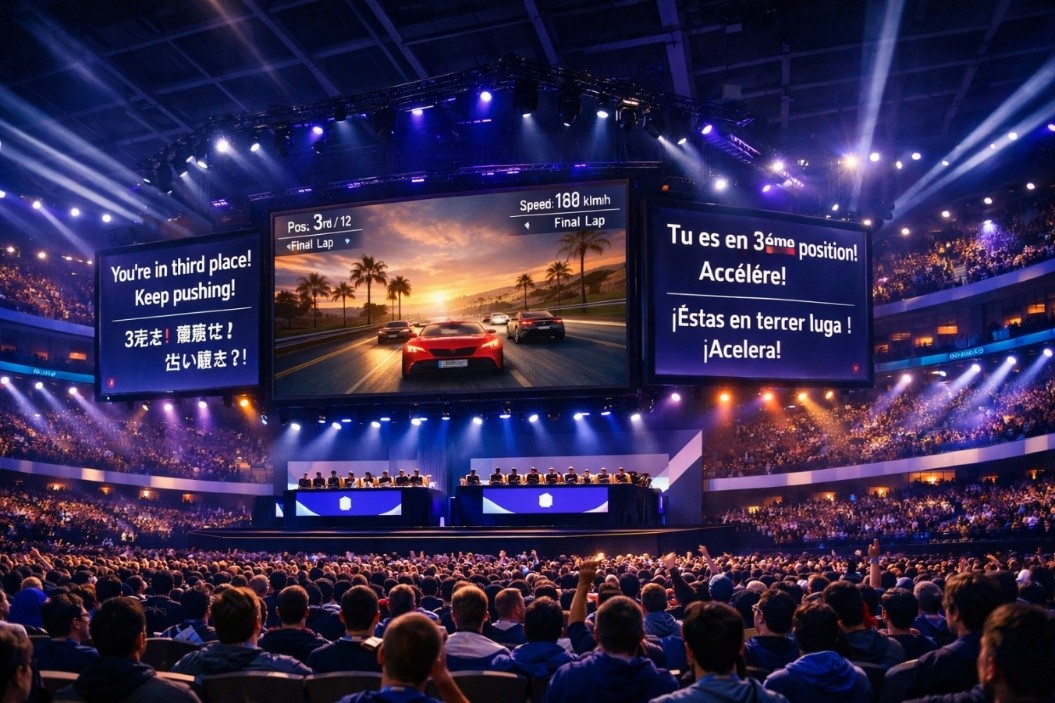
A localização ao vivo acontece em tempo real, sem uma segunda tomada e sem revisão prévia de qualidade. Isso a torna uma disciplina completamente diferente da legendagem pré-gravada, e é uma das áreas de crescimento mais rápido no streaming.
Eventos ao vivo e híbridos, fast channels, eventos esportivos e shows precisam de localização no momento em que acontecem. Por isso, dependem de legendagem ao vivo, CART (legendagem em tempo real feita por legendadores certificados), legendagem e dublagem ao vivo e interpretação multilíngue, muitas vezes tudo ao mesmo tempo.
Isso também está chamando a atenção regulatória. A FCC, que estabelece as regras de closed caption para vídeo entregue pela internet,examinou recentemente a qualidade das legendas ao vivo e o papel da automação. A automação pura tem mais dificuldades exatamente nessas condições: falantes sobrepostos, ruído de multidão e mudanças rápidas de tópico. Um modelo humano-mais-IA não é uma preferência aqui. É uma exigência e uma parte central do que a eSteno faz.
Como Escolher um Parceiro de Localização?
Escolha um parceiro que combine fluxos de trabalho reais com IA e expertise humana, não resultado bruto de máquina vendido como trabalho finalizado. O mercado para OTT está cheio de provedores de baixo custo que usam tradução automática com supervisão mínima. Isso pode servir para clipes informais, mas não para conteúdo premium que carrega sua marca.
Ao avaliar serviços de legendagem e dublagem, procure por:
- Experiência direta em OTT, com entregas compatíveis com as principais plataformas, como Netflix, Amazon, Disney+ e Apple
- Um fluxo de trabalho genuinamente assistido por IA com revisão humana incorporada
- Linguistas nativos que atuam como consultores culturais
- Credenciais de segurança de conteúdo, como a certificação TPN Gold Shield
- Controle de qualidade transparente, com verificações automatizadas mais revisão humana
- Cobertura de toda a gama de acessibilidade (SDH, legendas e audiodescrição) e para conteúdo tanto ao vivo quanto pré-gravado
Com mais de 25 anos de experiência nos setores de televisão, distribuição de conteúdo, corporativo, educacional e governamental, a eSteno Media Services oferece uma gama completa de soluções de localização e acessibilidade, desde legendagem e dublagem até CART ao vivo e criação de metadados, em inglês, espanhol e português, tudo sob a certificação TPN Gold Shield. Como a empresa diz, não é apenas o que fazem, mas como fazem.
Conclusão
O público global de streaming é maior do que nunca, e cresce mais rápido onde o inglês não é a primeira língua. Serviços sólidos de localização para OTT não são mais opcionais. A IA sozinha não consegue chegar lá, mas a IA combinada com expertise humana consegue. Esse modelo híbrido é como os melhores provedores de streaming protegem a qualidade, atendem às regras de acessibilidade e alcançam públicos globais na velocidade que o mercado exige.
Pronto para Levar Seu Conteúdo OTT para o Mundo?
Na eSteno, oferecemos serviços de localização OTT com assistência de IA, com o suporte de Na eSteno, oferecemos serviços de localização para OTT assistidos por IA e apoiados por expertise humana. De legendas compatíveis com plataformas e SDH até dublagem, audiodescrição e legendagem ao vivo, ajudamos seu conteúdo a alcançar o público certo, no idioma certo, com a qualidade certa. Entre em contato com nossa equipe hoje para uma avaliação de localização gratuita.especialistas humanos. De legendas compatíveis com a plataforma e SDH a dublagem, audiodescrição e legendagem ao vivo, ajudamos seu conteúdo a alcançar o público certo, no idioma certo e com a qualidade certa. Entre em contato com nossa equipe hoje mesmo para uma avaliação gratuita de localização.
Obtenha uma Avaliação de Localização Gratuita da eSteno
Perguntas Frequentes
Por que a IA sozinha não é suficiente para a localização OTT? A IA é rápida na transcrição e tradução. No entanto, é pouco confiável em expressões idiomáticas, referências culturais, áudio ao vivo sobreposto, acessibilidade e conformidade com plataformas. Um modelo não sabe quando está errado, então linguistas humanos precisam tomar as decisões finais.
Qual é a diferença entre legendas, closed captions e SDH? As legendas mostram o diálogo falado, muitas vezes traduzido. Os closed captions e o SDH acrescentam identificação de falantes, efeitos sonoros e indicações musicais para espectadores surdos e com deficiência auditiva. A maioria das plataformas exige closed caption ou SDH como parte de um pacote completo.
O que é audiodescrição? A audiodescrição é uma faixa narrada que descreve informações visuais importantes para espectadores cegos e com baixa visão. Ela é sincronizada nas pausas do diálogo e é cada vez mais esperada em conteúdo premium de streaming.
Em que a localização ao vivo difere da pré-gravada? A localização ao vivo acontece em tempo real, sem uma segunda tomada. Ela depende de legendagem ao vivo, CART, legendagem em tempo real, dublagem e interpretação. É também onde as ferramentas somente automatizadas mais enfrentam dificuldades.
O que são legendas compatíveis com a Netflix? As legendas compatíveis com a Netflix atendem aos padrões do Guia de Estilo para Legendas da Netflix: limites de caracteres, velocidade de leitura, formato de arquivo e mais. Arquivos que falham são rejeitados antes da publicação. Consulte a Central de Ajuda para Parceiros da Netflix.
A IA pode substituir linguistas humanos? Não para conteúdo premium. A IA acelera o fluxo de trabalho, mas não consegue lidar de forma confiável com nuances, humor, acessibilidade ou conformidade. Funciona melhor como uma ferramenta para linguistas experientes, não como substituta.
Quanto tempo leva a localização para OTT? Depende da duração e do tipo. A localização de legendas para um episódio de 30 minutos geralmente leva uns poucos dias úteis. A dublagem completa pode levar algumas semanas, incluindo elenco e gravação. Planejar com antecedência evita correrias de última hora.